Health and Environmental Assessment Laboratory (HEAL) Service Center
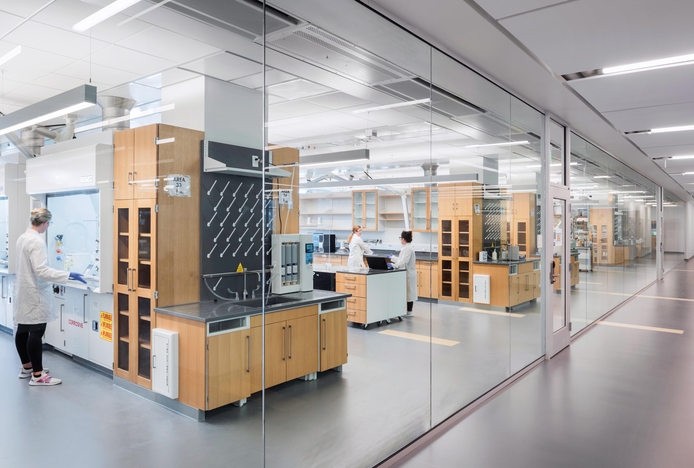
The HEAL Service Center is housed in HST Building L150 within the College of Health at Lehigh University. The service center includes bench space for sample processing and analysis within the 36,000 sqft of collaborative, open-concept laboratories.
The HEAL Service Center accommodates a wide range of project needs, from simple targeted quantification of a handful of compounds to large-scale omics studies. With both a Thermo Scientific Vanquish UHPLC and a Vanquish Neo UHPLC, the lab can run separations across a wide range of flow rates, from analytical and microflow methods through capillary and nanoflow, and choose the one that best fits each project. Microflow-based proteomics workflows are capable of detecting close to 3,000 proteins from a single sample, and nanoflow capability extends this to studies that need greater sensitivity from very limited material. On the metabolomics side, both targeted and untargeted approaches are available across a broad range of biological and environmental matrices, covering studies that link environmental exposures to molecular-level changes in the body. Support is available at every stage, from sample preparation and method development through data analysis and interpretation.
Located in Bethlehem, PA, our facility is just one hour from Philadelphia and New York City, providing convenient access for researchers and industry partners across the region. This central location makes it easy to run biological samples on our state-of-the-art instrumentation without the delays and logistics of long-distance travel.
Our Mission
The mission of the HEAL Service Center is to advance collaborative research by providing accessible, state-of-the-art mass spectrometry and analytical support to faculty, academic partners, and industry in the greater Lehigh Valley region, fostering innovation and empowering investigators to achieve their scientific goals.
Lehigh University’s College of Health established the HEAL Service Center in 2024, serving internal faculty, external academic partners, and industry collaborators across the greater Lehigh Valley region. The center houses highly valuable instrumentation, including a high-resolution mass spectrometer with two liquid chromatography systems and dedicated operational support, giving researchers reliable, long-term access without the burden of managing equipment independently. By centralizing these resources within the College of Health, the center connects investigators across disciplines, strengthens the university’s research capacity, and helps faculty compete and prepare for grants. Researchers at any stage of a project are welcome, whether they need a quick targeted analysis or are building a large-scale study from the ground up.
Our Equipment Capabilities
The lab is built around two Thermo Scientific liquid chromatography systems, a Vanquish UHPLC and a Vanquish Neo UHPLC, coupled to a Q Exactive Orbitrap Mass Spectrometer. Together they form a high-resolution platform supporting both metabolomics and proteomics workflows for targeted and untargeted analysis across a broad range of sample types.
Flexible flow rates for every application. Having both systems means HEAL can match the chromatography to the question being asked:
- Vanquish UHPLC for analytical- and microflow methods, with flow rates from 1 µL/min to 8 mL/min at pressures up to 1000 bar. These are robust and well suited to metabolomics, lipidomics, environmental screening, targeted quantification, and microflow proteomics.
- Vanquish Neo UHPLC for nano-, capillary-, and microflow methods, with flow rates from nanoliters per minute up to 100 µL/min at pressures up to 1500 bar. Nanoflow separations concentrate analytes into a very small volume before they reach the mass spectrometer, increasing sensitivity for low-input and precious samples.
Researchers bring biological samples including blood, plasma, serum, urine, saliva, nasal fluid, gut microbiota, and tissue, as well as environmental samples such as water runoff and wastewater. For metabolomics, these matrices are analyzed to detect and quantify small molecules that reflect environmental exposures and their effects on the body. For proteomics, the lab uses a bottom-up (shotgun) approach where proteins are first digested into smaller peptide fragments, which are then separated and identified by the mass spectrometer, making it possible to profile thousands of proteins from a single sample and link changes in protein expression to environmental stressors and health outcomes.
- Deeper proteome coverage. Nanoflow, bottom-up proteomics with long, high-resolution columns improves peptide separation before the Orbitrap, so more proteins can be identified and quantified.
- More from limited samples. Higher sensitivity at low flow rates means useful data from small tissue pieces, nasal fluid, limited clinical aliquots, or low cell numbers.
- Throughput and robustness where it counts. Microflow methods on the Vanquish provide rugged, high-throughput analysis for larger cohorts, while the Vanquish Neo provides depth when sample amount is the limiting factor.
- Reproducibility across large studies. Active flow control and high-pressure-capable hardware on the Vanquish Neo support stable retention times across long sample sequences, making samples easier to compare and quantify.
- Efficient sample use. The Vanquish Neo’s low-volume autosampler design, fast sample loading and column equilibration help limit carryover and idle time between injections.
- One lab, many workflows. Proteomics, metabolomics, lipidomics, and environmental analyses can each run at the flow rate that suits them, so investigators with very different questions can work with one team.
The HEAL Service Center accommodates a wide range of project needs, from simple targeted quantification of a handful of compounds to large-scale omics studies. Support is available at every stage, including sample preparation, method development, data analysis, and interpretation.
Our Services
Environmental Contaminant Screening
The lab analyzes water, wastewater, runoff, soil, dust, and airborne particulate samples for a wide range of chemical contaminants, with detection sensitivity down to trace levels.
- Pesticides, herbicides, and industrial chemicals
- PFAS and other persistent organic pollutants
- Antibiotics, drug residues, and personal care product ingredients
- Targeted analysis of known compounds and untargeted screening for unknown or unexpected chemicals
Metabolomics and Lipidomics
The lab detects and quantifies thousands of small molecules in a single run across a broad range of biological and environmental matrices, including blood, plasma, urine, saliva, nasal fluid, tissue, and wastewater.
- Targeted metabolite panels for known compounds
- Untargeted metabolomics for discovery-driven research
- Flexible flow-rate options for low-abundance analytes and sample-limited studies
- Applications in nutrition, environmental exposure, inflammation, oxidative stress, and disease biomarkers
Proteomics
Using a bottom-up shotgun approach, the lab identifies and quantifies proteins from cells, tissues, plasma, urine, and other biological fluids. Microflow workflows routinely detect close to 3,000 proteins per sample, and nanoflow LC-MS on the Vanquish Neo provides added sensitivity for limited or precious samples.
- Biomarker discovery and protein expression profiling
- Pathway analysis and exposure-response studies
- Nanoflow and microflow options for deep proteome coverage from limited sample amounts
Targeted Quantification
For projects requiring precise, reproducible measurement of specific compounds, the lab develops validated methods using calibration and internal standards.
- Pollutant monitoring across environmental sampling sites
- Biomarker quantification in clinical cohorts
- Drug compounds and their metabolites
- Longitudinal tracking of specific chemicals across timepoints
Method Development and Consultation
The lab works with researchers at every stage, from initial study design through data interpretation.
- Sample collection and preparation guidance
- Selection of the appropriate LC system and flow rate for your samples and goals
- Custom method development for new sample types or analytes
- Data analysis support
- Training for students and researchers new to mass spectrometry
Research Success Stories
Integrative Multiomic Analysis Reveals How Non-Viral Delivery System Selection Shapes CRISPR Gene Editing Outcomes in Stem Cells
A Lehigh team led by Dr. Tomas Gonzalez-Fernandez compared cell-penetrating peptides, lipid and polymer nanoparticles, and electroporation for delivering CRISPR gene editing into primary human mesenchymal stem cells. To see how each method affected the cells at the protein level, digested peptide samples were analyzed at HEAL on our LCMS, using a microflow gradient and DDA method. Label-free quantification showed that interferon-stimulated proteins such as IFIT1, IFIT2 and IFIT3 were elevated after lipid and polymer delivery but not after peptide delivery or electroporation, and lipid delivery also enriched STAT1, OASL and RIG-I. These results confirmed at the protein level the inflammatory response seen in RNA sequencing. Combined with editing and macrophage co-culture data, the study showed that the delivery method with the highest editing rate also carried the greatest cellular stress, so editing efficiency alone is not enough to choose a delivery system for stem cell therapies.
Graham JP, Arteaga AV, Moghaddam AS, Spiller KL, Laverty DJ, Gonzalez-Fernandez T. Integrative Multiomic Analysis Reveals How Non-Viral Delivery System Selection Shapes CRISPR Gene Editing Outcomes in Stem Cells. bioRxiv preprint, 2026. doi:10.64898/2026.05.29.728905
Contact the HEAL Service Center
The service center has established a clear point of contact for service requests, billing and payment, other communications and service center announcements.
Email: inhealt@lehigh.edu
Frequently Asked Questions
Do I need prior experience with LC-MS/MS to use the facility?
No. We offer both self-service (for trained users) and staff-run services. If you are not trained, our staff can run your samples and assist with method development and data acquisition.
Do I need training to operate the instrument myself?
Yes. Only authorized and trained users are permitted to operate the LC-MS system independently. Training must be completed through the HEAL Service Center, and users may only operate within the scope of that training.
Can I let someone else run samples under my account?
No. Instrument access is strictly limited to authorized users. Allowing untrained or unauthorized individuals to use the instrument under your account is not permitted.
Which LC system and flow rate will my samples be run on?
HEAL has both a Vanquish UHPLC and a Vanquish Neo UHPLC, covering flow rates from analytical and microflow through capillary and nanoflow. Our team will help you choose based on your sample type, the amount of material available, and your study goals. Nanoflow is typically the best choice when sample is limited or maximum proteome depth is needed, while higher-flow methods are well suited to large cohorts, metabolomics, and environmental analyses.
How long does an LC-MS run take?
Run times vary depending on the method and sample type, but typically range from 10 minutes to 2 hours per sample. Longer or specialized methods may require additional time.
What if I don’t know which LC-MS method is appropriate for my samples?
No problem. We offer method development and sample preparation services tailored to your sample type. Our team will work with you to identify the most appropriate method and optimize conditions for your analysis.
How can I get pricing or rates for using the LC-MS?
For current rates and billing information, please contact us at inhealt@lehigh.edu or abs421@lehigh.edu.
Does the HEAL Service Center provide columns, reagents, and supplies?
Yes. We provide access to columns, solvents, reagents, and other consumables required for sample preparation and analysis. These materials will be charged to the user based on usage.
Can I just drop off my samples and receive results?
Yes. We offer a fully staff-run service, where you can submit your samples and our team will handle preparation (if needed), data acquisition, and initial processing.
Do you provide help with data analysis?
Yes. We can assist with data processing and interpretation, depending on the project scope. Please contact us in advance to discuss your analysis needs.
Can I submit unknown samples?
No. We do not accept completely unknown samples, as they may damage the instrument or contaminate the system.
What is considered an “unknown sample”?
An unknown sample is one where the chemical composition, properties, or potential interactions are not understood.
Acceptable: - Biological samples with known origin (e.g., cell lysates, digested proteomics samples) - Samples that are properly prepared and validated (e.g., confirmed digestion via SDS-PAGE)
Not acceptable: - Samples with unknown chemical composition - Materials that may react unpredictably with solvents, columns, or the instrument
If you are unsure, please contact the facility before submitting your samples.
What solvents are allowed?
Samples must be prepared in LC-MS compatible solvents, including: - Water - Methanol - Acetonitrile
Small amounts of formic acid or acetic acid are acceptable. Any other solvents or additives must be disclosed and approved in advance.
What types of samples are prohibited or restricted?
The following are not allowed without prior approval: - High concentrations of nonvolatile salts or buffers - Strong acids or bases out of acceptable pH ranges - Particulates or poorly dissolved samples - Polymers - Proteins - Reactive or unstable compounds - Any high molecular weight or big molecules
Additional considerations: - Proteins are allowed only if properly prepared, such as enzymatically digested (e.g., trypsin digestion) and free of high molecular weight species. - Samples containing large or high molecular weight components (e.g., intact proteins, aggregates, or poorly characterized macromolecules) may not be accepted unless reviewed and approved in advance. - Radioactive, biohazardous, or infectious materials are not permitted on this instrument.
How should I prepare my samples?
To ensure instrument safety and data quality: - Remove particulates (0.22 µm filtration recommended) - Ensure samples are fully dissolved - Keep protein concentration ≤ 0.5 mg/mL (for proteomics samples) - Use appropriate vials and clearly label all samples
Improper sample preparation may result in rejection or poor data quality. Nanoflow analyses are especially sensitive to particulates, so careful filtration and clean sample preparation are important.
What happens if my sample damages the instrument?
Users’ labs are financially responsible for any damage, contamination, or service costs resulting from improper sample submission or misuse.
How do I schedule instrument time?
All instrument usage must be scheduled in advance through inhealt@lehigh.edu or abs421@lehigh.edu.
Users must: - Use only their reserved time slot - Cancel at least 48 hours in advance if needed - Ensure runs finish within the reserved time unless approved otherwise
What should I do if something goes wrong during a run?
If you observe issues such as: - Pressure spikes - Leaks - Unusual noises - Signal instability
Stop the run (if safe) and contact HEAL staff immediately. Do not attempt repairs yourself.
How long is my data stored?
The facility stores raw data for up to 6 months. After that, data may be permanently deleted. Users are responsible for downloading and backing up their data immediately after acquisition.
Who is responsible for compliance and safety?
All users must follow: - HEAL Service Center policies - Institutional safety guidelines
Failure to comply may result in loss of instrument access.
Discuss Your Project With HEAL
Whether you need targeted compound analysis, omics support, method development, or guidance on sample preparation, HEAL’s team can help you determine the right analytical approach for your research. Contact us to discuss your samples, study goals, timeline, and service needs.