
Research and Partners
The Nexus of Health and Innovation
The College of Health is the nexus of health research at Lehigh. Our mission is to improve the health and well-being of the people of communities across the country and around the world, as well as the greater Lehigh Valley.
$22M+ | 250+ | 39 | 100% | R1 |
|---|---|---|---|---|
| Grant Dollars Awarded Since 2020 | Peer-Reviewed Publications | Faculty Members | of Faculty Conducting Ongoing Research | Carnegie Classification |
Have questions about our research or wish to partner with the College of Health on future projects? Please reach out to us at inrsrch@lehigh.edu.
Many projects investigate disease transmission and prevention, including modeling outbreaks, understanding Norovirus, and studying tuberculosis adherence. Several initiatives address social determinants of health and health equity, such as maternal resilience, healthcare disparities, and the health of incarcerated women. Other areas of focus include improving healthcare systems and patient experiences, like hospital operations, medical billing literacy, and new care delivery models, alongside community-based interventions aimed at reducing stigma, promoting health literacy, and fostering well-being.
The College of Health accomplishes its work through partnerships. We partner internally at Lehigh with colleagues in business, engineering, education, and the arts and sciences in multidisciplinary collaborations that reflect the complex nature of any health challenge. We collaborate with a range of external partners – from corporations and foundations to health networks and government agencies – who work with communities and share our goals to address some of society’s most pressing health challenges.
Explore the many benefits of partnering with the College of Health
Areas of Research
- Improving the health of global & Indigenous populations
- Exploring the impact of the built environment and greenspace
- Modeling of infectious diseases for prediction and control
- Creating interventions to improve mental & behavioral health
- Addressing maternal & child health issues
- Integrating health data science & technology, as well as qualitative methods
- Examining health policy & ethics in healthcare, and economics of health systems
- Tackling issues of addiction and substance use (smoking, alcohol, etc)
- Assessing environmental factors (air, water, etc) on health
- Improve human health primarily by evaluating the determinants of health that exist outside of the healthcare system.
Faculty Societal Impact Profiles
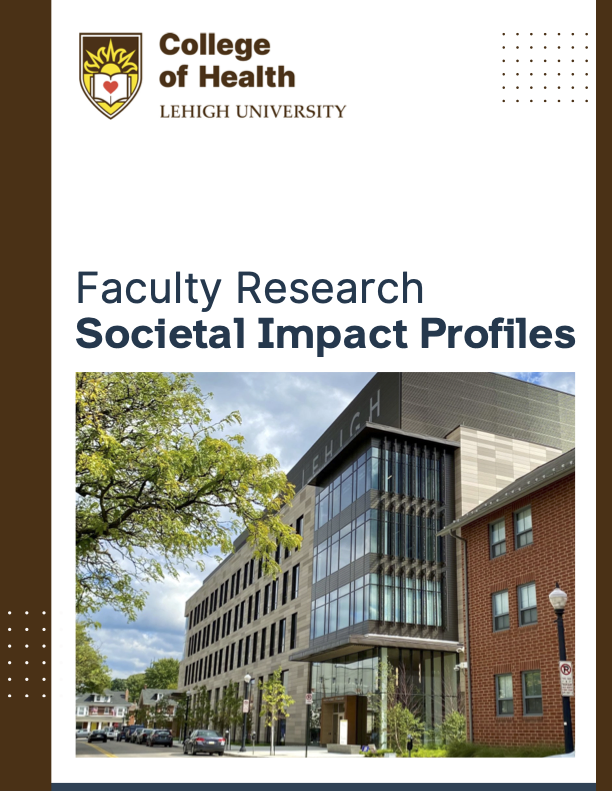
Faculty Societal Impact Profiles
The following faculty profiles showcase our social impact across five transformative areas:
Culture and Community | Data-Driven Innovation | Economy | Education | Policy
Publications & News
Research News >>
Austin Duncan
Providers' Perspectives: Factors that Influence Homelessness Service Provision in Arizona, United States
International Journal on Homelessness
Rochelle Frounfelker
"Stuck in between two worlds": Substance misuse among first-generation ethnic-Nepal Bhutanese youth and young adults with a refugee life experience
SSM-Qualitative Research in Health
Gideon Gogovi
A Molecular Dynamics Study of Polyacrylamide Conformational Changes in Ca2+ and Mg2+ Solutions
ACM International Conference on Bioinformatics, Computational Biology and Health Informatics
Russell McIntire
Teachers' Perspectives on the Impact of an Outdoor-based Self-Care Training Program on Student Mental Health.
International Journal of Environmental Research and Public Health
Jong Shin
A cross-sectional study on exercise participation and barriers among older adults
Journal of Exercise Rehabilitation
Fathima Wakeel
Qualitative exploration of the efficacy of documentary film in promoting maternal health in Sierra Leone
Global Health Promotion
Research Administration Support
Lehigh University is adopting a decentralized approach to research management, enhancing support for faculty with a visible first point of contact. As a pioneering effort for the University, faculty within the College of Health benefit from a dedicated team of professionals, administrative staff, and research personnel at the college level. This structure offers a comprehensive suite of support services aimed at streamlining research operations and fostering a thriving academic environment.
A key component of this support system is the college’s employment of two full-time, professional Research Administrators—Contract & Grant Coordinators—who specialize in both pre-award and post-award support. These roles are critical in managing the administrative and financial aspects of research projects, allowing faculty to focus on their scholarly work.
Contract & Grant Coordinator (Pre-Award)
- Facilitates funding proposal development
- Supports ideation and team-building efforts
- Provides document review and editorial support
- Facilitates budget development
Contract & Grant Coordinator (Post-Award)
- Administers payroll for research project staff
- Facilitates accounts payable and contract review
- Provides assistance with OneCard transactions
- Conducts financial management and expense review
To further strengthen research oversight and management, the college employs an Associate Director of Research Administration and an Associate Dean for Research & Graduate Education. These roles are integral to shaping research strategy and providing leadership in proposal development and financial award management. Their expertise ensures that research initiatives are well-supported and aligned with the College’s strategic goals.
By prioritizing research management and student success, the College of Health establishes a holistic support network that empowers faculty, enriches student experiences, and strengthens the institution’s research and academic mission.
Frequently Asked Questions
College of Health research produces peer-reviewed scholarship, community interventions, new technologies, policy-relevant findings and tools that translate evidence into practice. Examples include infectious-disease forecasting for public-health decision-making, immersive training technologies, maternal-health education, and community-based work addressing health disparities. Since 2020, College faculty have secured more than $22 million in grant awards and published more than 250 peer-reviewed works.
Corporations, foundations, nonprofit organizations, healthcare systems and government agencies can collaborate with College of Health researchers through sponsored research, philanthropic support, data-sharing initiatives and applied projects. Prospective partners can begin by contacting the College’s research team at inrsrch@lehigh.edu to discuss the health challenge, desired outcomes, available funding or data, and the faculty expertise needed. Lehigh’s Office of Research and Sponsored Programs supports proposal submission, agreement review and negotiation, award setup, reporting and project closeout.
Funding opportunities span infectious-disease modeling; mental and behavioral health; maternal and child health; global and Indigenous health; environmental health; addiction and substance use; health policy, services and ethics; the built environment; and health data science and technology. Projects may use community-based participatory research, qualitative and mixed methods, epidemiology, intervention design, advanced analytics, laboratory resources and health-data infrastructure.
The College provides dedicated pre-award and post-award research administration support, including proposal and budget development, payroll administration, accounts payable, contract review, financial management and expense review. At the university level, the Office of Research and Sponsored Programs supports award acceptance, account setup, sub-awards, sponsor financial and progress reporting, monitoring and closeout. Research involving human participants is reviewed and monitored by Lehigh’s Institutional Review Board, and approval is required before covered research begins.
Evaluation can be aligned with each sponsor’s goals and award terms, using measures such as project milestones, peer-reviewed publications, community reach, intervention outcomes, datasets or tools developed, student research opportunities, translation into policy or practice, and follow-on funding. Lehigh supports required financial, progress, nonfinancial and technical reporting, while College research commonly emphasizes real-world application and community impact. Reporting expectations, indicators, cadence and deliverables should be defined with the research team during proposal development so that funders receive evidence appropriate to the project and award.
Discuss a Research Funding or Partnership Opportunity
Learn How We Can Best Partner With You