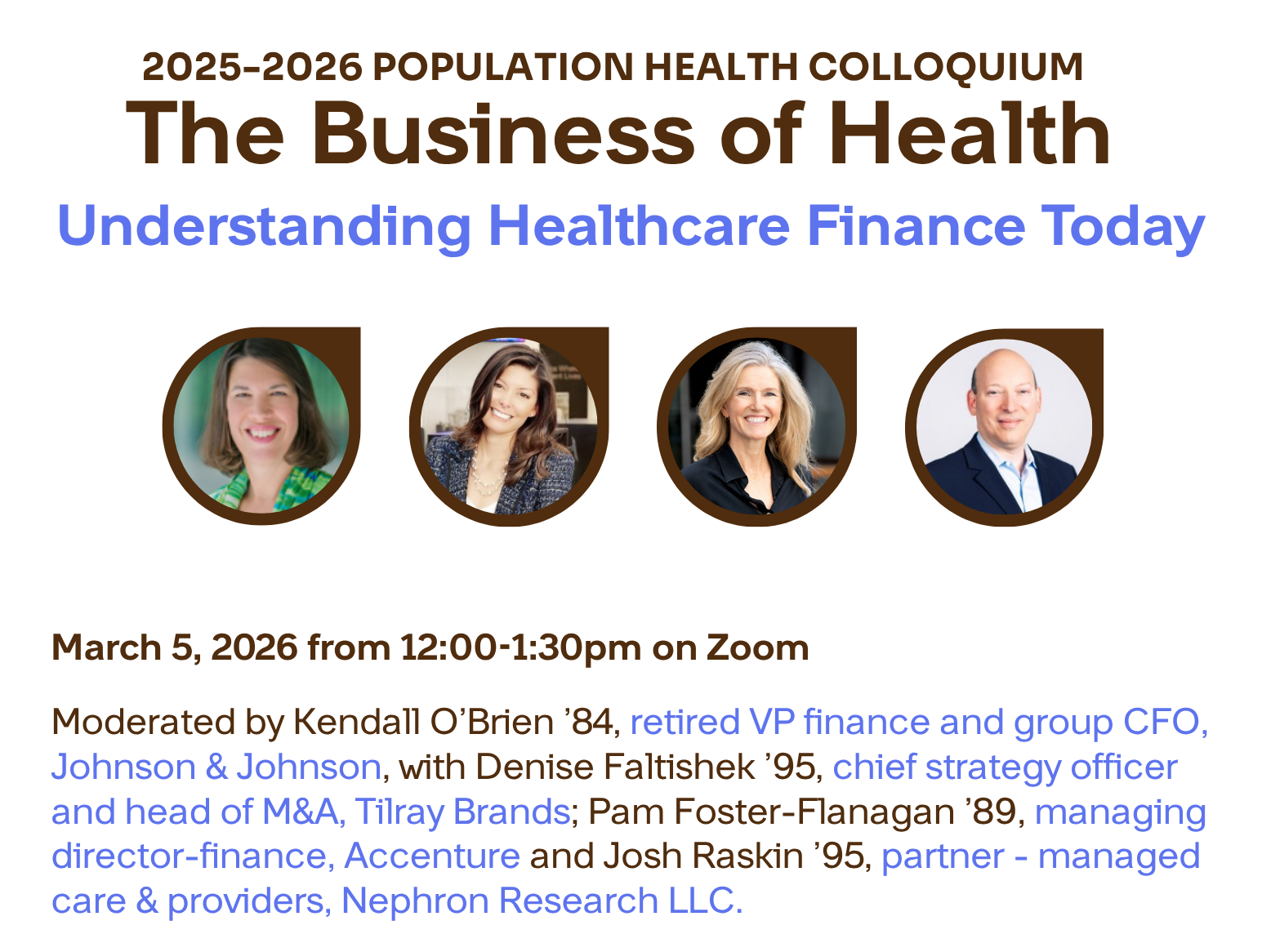
On March 5, the College of Health and the College of Business hosted the fifth event in the 2025-26 Population Health Colloquium series, “Understanding Healthcare Finance Today.” This series celebrates the new intercollegiate program in Integrated Business and Health, which welcomed its first cohort in the fall semester.
The session was moderated by Kendall O’Brien ’84, retired VP finance and group CFO; Johnson & Johnson. Joining her on the panel were Denise Faltishek ’95, chief strategy officer and head of M&A, Tilray Brands; Pam Foster-Flanagan ’89, managing director-finance, Accenture; and Josh Raskin ’95, partner – managed care & providers, Nephron Research LLC.
O’Brien set the stage with context: in 2024, healthcare spending in the United States was over $5.3 trillion, representing a significant percentage of the nation’s gross domestic product (GDP). The healthcare sector has grown significantly and is now the largest employment sector in the U.S. Despite spending more on healthcare than any other developed country, the United States does not achieve comparable quality outcomes, with life expectancy lagging behind that of other nations.
O’Brien asked the panelists to share how they started their careers in the financial side of the healthcare industry. After graduating from the College of Business, Raskin worked at PricewaterhouseCoopers before moving into finance roles at Morgan Stanley and Lehman Brothers. He then “lucked” into healthcare after helping to start a healthcare services team.
Faltishek, who initially planned to attend medical school, worked in healthcare for a few years after graduation from Lehigh. With an interest in policy, she attended law school to advocate for patient rights, but instead became a corporate lawyer. She later worked in-house for a health and wellness company called Hain Celestial Group before joining Tilary Brands.
Foster-Flanagan, meanwhile, spent her entire career at Accenture, joining the firm 36 years ago after graduating from Lehigh. In her current role as a consultant in healthcare, she said she is “leveraging my finance powers for good, and my consulting powers to help a client tackle their challenges.”
The conversation then turned to fiduciary responsibility. Foster-Flanagan said that because she is in the business of selling services to a client, she has to deliver services for a fair and balanced price that supports an industry that is not solely profit-driven. In her role, Faltishek analyzes costs associated with providing an alternative to traditional pharmaceutical products to ascertain whether they are providing an effective and affordable product.
O’Brien asked the panelists for their thoughts on spending in the U.S. market compared with other countries. Foster-Flanagan pointed to cost pressures resulting from changing U.S. demographics and an aging population. “We need a fundamental shift in how we deliver care because there is actually a fundamental shift in the care that’s needed.”
Raskin explained how the United States has a private/public partnership, unlike many countries with government-run healthcare, and said that “the biggest difference in the United States versus other countries is unit cost.” Also, a “huge majority of the innovation has actually come out of the United States system,” he said. “We could argue we’re paying more for it, and it costs a lot, but we’re getting some of the best healthcare and creating value way beyond our own borders.”
The group considered challenges with regulatory pathways for new drug development in the United States and globally, as well as value-based care, a healthcare delivery model in which providers are paid based on patient health outcomes rather than the number of services they deliver. They also explored the reasons behind the lack of greater investment in wellness and prevention.
The panelists closed the session by offering advice to students. According to Raskin, healthcare offers a massive and exciting diversity of career opportunities. Foster-Flanagan recommended that students pursue a career which is human-centered, due to the rise of AI. Faltishek said, “Even if you get into one area of healthcare, just keep your eyes and ears open because life takes you down a lot of different turns, and it keeps things very interesting for sure.”
O’Brien noted the importance of wanting to make a difference for the patients.
“The privilege of being in this industry is that you can do something to hopefully make it better for someone else,” she said. “You don’t have to be the healthcare expert. My gifts are finance and strategy.”
Join us on April 7 for “NextGen Health: Startup Leaders on the Future of Care,” the final Colloquium event of the year, where we will spotlight Lehigh alumni entrepreneurs shaping the future of healthcare through innovation, technology, and new care models — and explore what their work means for the business of health.


