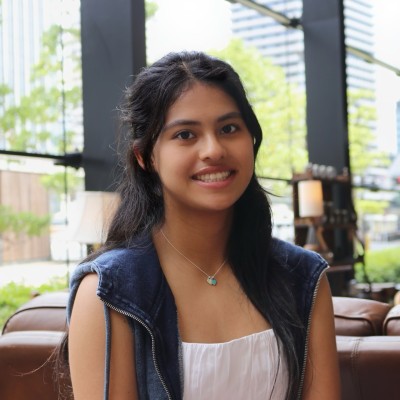
Many sophomores are just beginning to explore their fields. College of Health (COH) student Tara Chelvam ’28 is already helping to shape global conversations through Lehigh University’s partnership with the United Nations.
In February, Chelvam co-led a virtual global event for the United Nations (UN) Commission for Social Development, which provides advice to the UN on social development issues. As a UN Youth Representative, she presented on behalf of CLAN (Caring & Living as Neighbours), an Australian non-governmental organization (NGO) that works with global partners to advance equity for children living with non-communicable diseases and other health conditions in resource-poor settings. The session focused on advancing social development and social justice through coordinated equitable and inclusive policies, specifically working towards a World Health Organization (WHO) resolution to include more language about newborn screening and the early detection of other non-communicable diseases.
“In more resourced countries, it’s really common for parents to go to the medical office, and they’re able to see if their children are prone to any of these illnesses or likely diagnosed with a certain chronic disease,” she said. “In some resource-poor settings, they don’t have that at all. It’s important for the WHO to acknowledge that they need to have this kind of language, so that their governments can work towards these efforts in resource-poor settings.”
Since Chelvam has always been fascinated by the structure of the UN, Lehigh’s UN Youth Representative program played a large role in her decision to attend the university. Her participation in the program has sparked her interest in chronic disease epidemiology and management. She has also learned about the importance of accounting for cultural context in implementing health policies and understanding the impact on the affected communities.
Through this program, Chelvam has coordinated events across time zones and presented at multiple UN events, including one with the Commission for the Status of Women alongside the COH’s Mohammed Jibriel, assistant professor, department of community and global health; United Nations faculty fellow. Chelvam said she is providing a platform at the UN for “communities that are doing revolutionary work in this field of ensuring access and healthcare to young children living with chronic health conditions. That’s the most rewarding part of the experience because it sheds light into the work that they’ve done.”
Chelvam’s global experience extends beyond the UN. As part of a Global Social Impact Fellowship in 2025, she traveled to Kazakhstan for her first research project. Over two weeks, her team conducted research “to determine how any kind of public health interventions would be successful in reducing sodium consumption in the country because they have high rates of cardiovascular disease,” she said. “Given the cultural history of the region, it’s largely attributed to their high consumption of processed meats.”
The project, Kazakhstan: SaltX - Reducing Sodium Consumption and Improving Nutritional Labeling, is run by Joseph Menicucci, associate chair and associate professor of chemical and biomolecular engineering in the P.C. Rossin College of Engineering and Applied Science. Chelvam contributed as a co-author on a teammate’s paper focused on labeling systems that would be helpful in middle-income countries, and is currently working on a literature review on implementing educational interventions in these areas.
On campus, Chelvam serves as the committee head for community outreach in the COH’s Student Advisory Council. In this role, she helped to organize their first community health fair, which brought multiple organizations from the South Bethlehem community to campus to showcase available resources. She felt it was an eye-opening experience for students, who may not have realized the disparity faced by some members of the community. Chelvam also enjoys speaking to prospective students at admissions events about the COH.
A population health major, Chelvam appreciates the interdisciplinary nature of her coursework, including epidemiology, population health, community and global health and biostatistics. She plans to minor in biostatistics and is eager to build her coding skills in R and Python in order to map and analyze disease patterns. She credits the COH’s Hsuan-Wei “Wayne” Lee, assistant professor, department of biostatistics and health data science, for making biostatistics accessible and enjoyable, and looks forward to an independent study in this field next fall under his mentorship. Next year, she will begin the COH’s 4+1 Accelerated Master’s Program, which allows undergraduates to earn both their bachelor’s degree and Master of Public Health (MPH) in five years.
Looking further ahead, Chelvam hopes to pursue her passion for chronic disease management and data analytics, particularly in a clinical data setting where she can support the development of new and affordable treatments. Through global advocacy, research and community building, Chelvam is already making her mark in public health. Her journey reflects the COH’s commitment to experiential learning, taking students out of the classroom and equipping them to apply their knowledge in meaningful, real-world settings.


