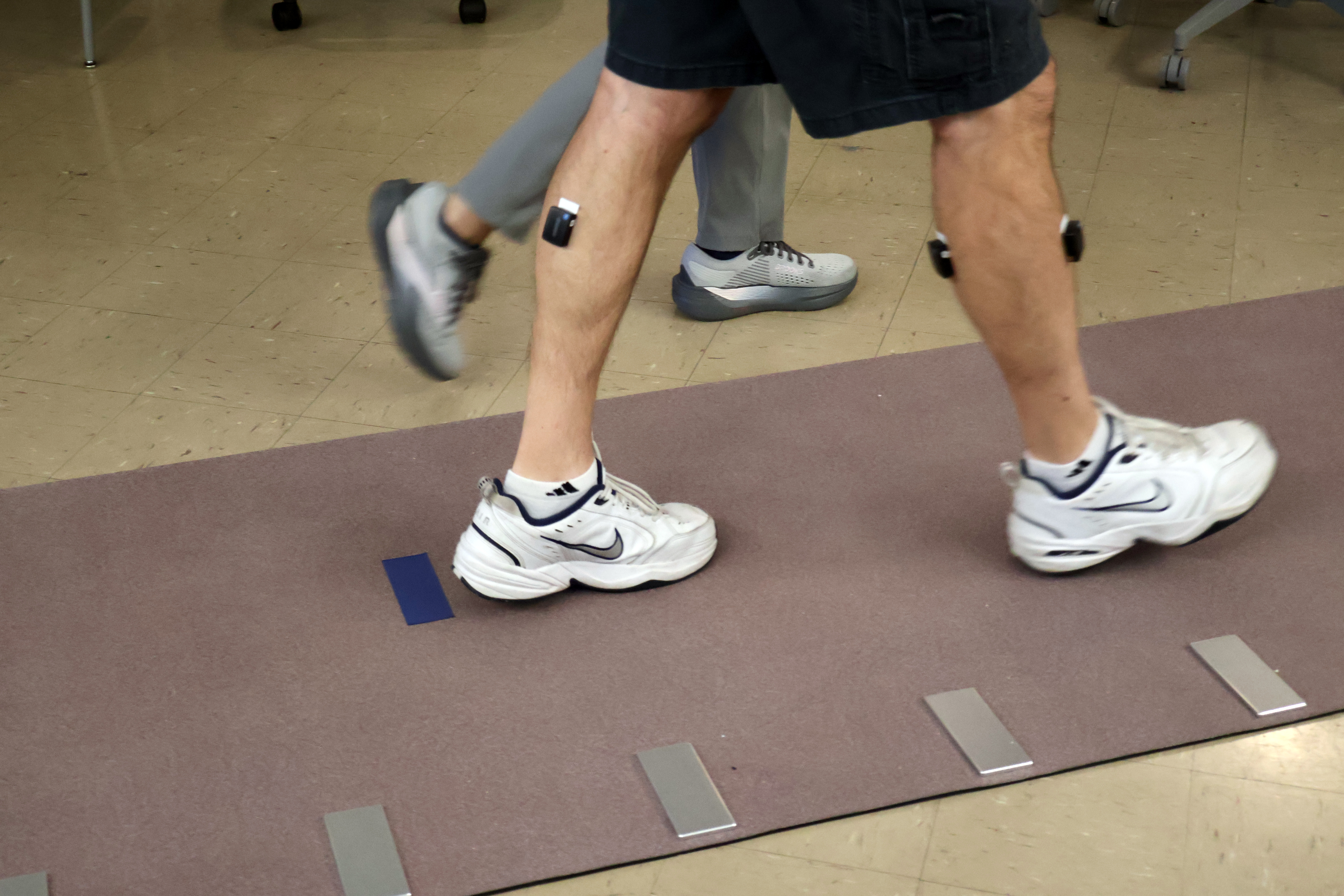
Imagine stepping into a virtual world while sensors embedded in wearable technology track the way that you move outside in the real world. For an individual with Parkinson’s disease, this opportunity gives researchers a detailed look into how the disease affects movement and offers insight into how it can be more effectively treated.
 That’s the focus of a new study led by Rui Hua, assistant professor, department of biostatistics and health data science at Lehigh University’s College of Health (COH). An electrical engineer by training, Hua runs the Smart Wearable Electronics and hEalth daTa (SWEET) Research Group, which is focused on developing wearable and artificial intelligence (AI)-powered digital health solutions in neurorehabilitation and remote patient monitoring for Parkinson’s disease.
“We’re developing a virtual reality platform with the use of wearable sensors to objectively evaluate gait impairments and freezing of gait in patients with Parkinson’s disease,” explained Hua. Freezing of gait is a symptom of Parkinson’s that refers to a temporary, involuntary inability to move, as if the patient’s foot is suddenly “glued to the floor.” It can lead to falls, limited mobility and reduced independence or quality of life.
According to Hua, when clinicians examine patients in a clinic, their movements can be very different than in real-world environments. “One of the reasons we’re developing this virtual platform is we want to standardize the environment across clinics, and build in daily life contexts, such as a doorway or hallway, and ask the participants to navigate through obstacles, while wearable sensors measure and quantify their gait. Then, working closely with clinicians, we’ll process and model these wearable data into clinically meaningful insights,” he said.
By using wearable sensing and virtual reality to help measure gait deficits, researchers hope to gain insights to help clinicians develop more personalized rehabilitation programs to improve patients’ mobility.
The project has received funding from Lehigh’s new Center for Community-Driven Assistive Technologies (CDAT), which aims to transform the lives of people with disabilities through interdisciplinary research and cutting-edge assistive technologies, both emerging and existing; and a recent student support award from Lehigh’s Institute for Data, AI, Society and Computation (I-DISC). I-DISC remains a hub to catalyze, support and promote research in areas related to data, intelligent systems and computation, especially interdisciplinary, collaborative research.
Hua’s team includes Carly Haffner, MS, OT/L, an occupational therapist with Good Shepherd Rehabilitation, a university-wide partner in the area of disability health equity. Mooi Choo Chuah, Ph.D., co-leads virtual reality development with Hua. She is a professor in the P.C. Rossin College of Engineering and Applied Science’s department of computer science and engineering. Jenny Bartoff, PT, DPT, Ph.D., NCS, assistant professor with Oregon State University-Cascades, is a clinical collaborator.
The research team also is studying how different types of auditory and tactile cues support mobility in individual patients. Working closely with clinicians from Good Shepherd Rehabilitation, the research team will examine how auditory cues, such as metronomes or music, and tactile cues, such as vibrations from a smart wearable device, can help Parkinson’s patients to synchronize their steps. According to Hua, there is currently no clear evidence that one approach is more effective than another.
“I think it’s going to be a personalized approach. Maybe the auditory cue will work for me, but not for another person. Maybe the wearable tactile cue will work for the other person, but not for me,” he said.
Hua is mentoring students from across the university through his lab, including Thoi Quach, a graduate student in the Rossin College who is the technical lead on the virtual reality project. The undergraduate team includes students pursuing pre-health pathways, including physical therapy and medicine, who contribute to different aspects of the project. This includes Noelle Barone, a major in psychology in the College of Arts and Sciences (CAS) and a minor in Health Policy and Politics in the COH, who is the lead of research coordination as the research engagement ambassador. Lillian Linnell, a major in population health and biology in the COH known as “DJ L.L. Beats,” is leading the project of music customization as auditory cues to help patients synchronize their steps. Meanwhile, Sophie Weiskopf, a major in community and global health in the COH, and Alex Lien, a biology major in the CAS and Health, Medicine and Society minor in the COH, are conducting clinician interviews to integrate clinician insights into the technology development.
The research studies are actively recruiting participants, closely partnering with the weekly Parkinson’s boxing program at Good Shepherd Rehabilitation Network and local Parkinson’s support groups.
By developing innovative new technologies that are poised to make a real-world impact, as well as collaborating with Good Shepherd Rehabilitation and Parkinson’s support groups, Hua’s work aims to advance disability health equity by helping to make rehabilitation more personalized and specific to the needs of people living with Parkinson’s disease.
To learn more about Hua’s work in the SWEET Group, please click here.


