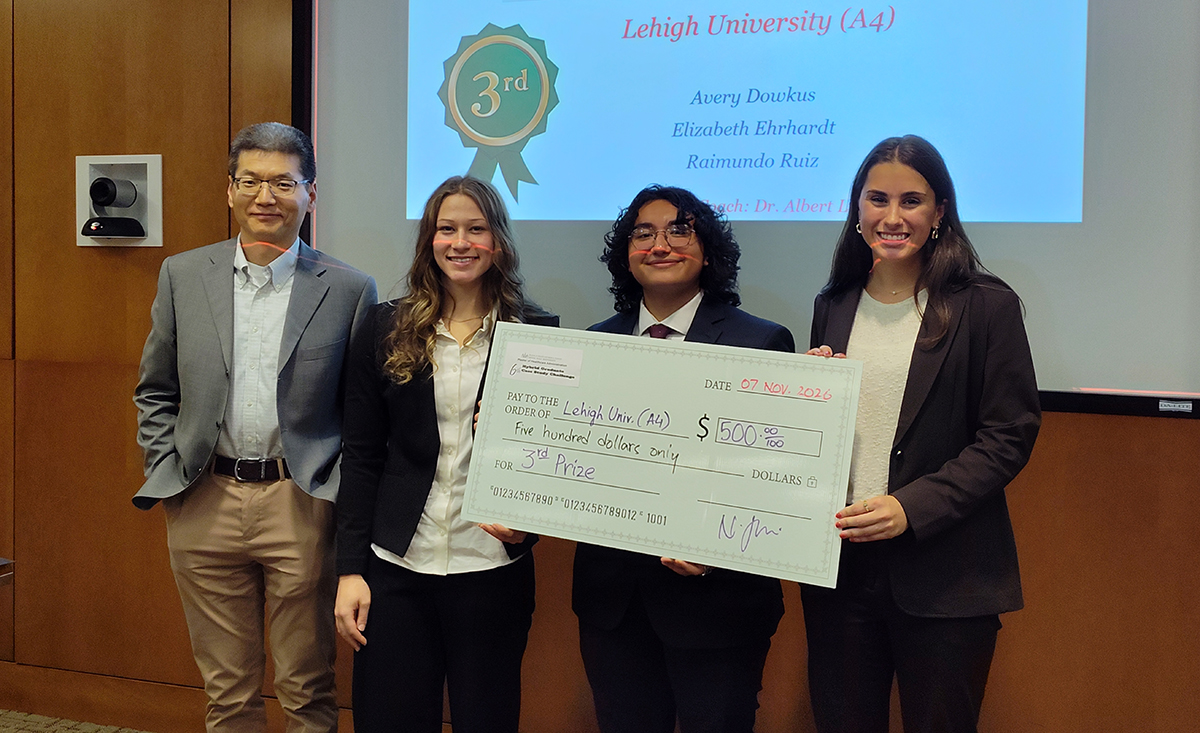
 Lehigh University College of Health students Avery Dowkus (second from left), Elizabeth Ehrhardt (right) and Raimundo Ruiz (second from right) earned third place and a $500 cash prize at Seton Hall University's Graduate Healthcare Management Sixth Hybrid Case Study Challenge on November 7, 2026. Pictured on the left with them is faculty advisor Albert Liu.
The students traveled to Seton Hall with their faculty advisor, Xinliang (Albert) Liu, associate professor and associate chair of the Department of Population Health, and finished third among five teams. Their achievement continues a strong record for Lehigh's College of Health and Liu, whose teams earned second place in both 2024 and 2025.
The regional competition brings together graduate students in healthcare administration to demonstrate critical thinking, leadership and professional presentation skills. Teams develop recommendations for a healthcare management case and present their work to a panel of experts.
A Strategy to Strengthen Rural Healthcare
For their entry, "Reclaiming Our Roots: Leaning into the Strengths of Our Rural Community for Long-term Success," the Lehigh team developed a turnaround strategy for a fictitious Juniper Valley Health System, the rural healthcare organization at the center of the case. Their approach paired immediate financial interventions with longer-term investments in leadership, employees and community relationships.
The case presented interconnected challenges: a 25-bed hospital facing financial distress, leadership turnover, staffing shortages and a surgical wing being underused. With only about 20 days of cash to cover operating expenses, the organization faced urgent financial pressures while preserving access to care.
The students' proposal connected the hospital's financial recovery to its ability to recruit and retain employees, establish consistent leadership and keep patients' care close to home.
Team member Elizabeth Ehrhardt said the experience “opened my eyes to the world of healthcare administration and showed me just how interdisciplinary the field is. I am walking away with stronger systems-level thinking, public speaking, and problem-solving skills.”
Balancing Urgent Needs With Long-Term Recovery
The team developed a 120-day action plan focused on improving billing and collections, auditing finances, stabilizing leadership and reducing supply costs through group purchasing. They also proposed exploring a partnership with a larger health system to provide capital and access to leadership and staffing resources.
Their three-year roadmap addressed the conditions needed to sustain that recovery. Recommendations included recruiting permanent executive leaders, building recruitment partnerships with colleges and medical schools, expanding surgical coverage and creating a workplace culture that would encourage employees to build lasting careers in rural healthcare.
Community connections were central to the proposal. The team recommended promoting an experienced nursing leader from within the organization, recruiting clinicians with ties to rural communities and emphasizing the value of delivering care where patients live. Financial projections examined both the proposed partnership strategy and an alternative scenario without a partner's capital investment.
The students framed their approach around four commitments: invest in people, cultivate a culture of care, build on rural strengths and establish long-term sustainability. Together, those priorities linked the hospital's recovery to the well-being of the community it served.
The experience unlocked new ideas in Raimundo Ruiz. He said, “This case study competition sparked a passion in healthcare administration I did not previously have. Overall, this project has inspired me to enter the field of healthcare administration and has given me valuable experience to reference and highlight as I work towards future opportunities.”
Team captain Avery Dowkus noted, “This experience allowed me to apply what I had learned in the classroom to real-world situations. It gave me a deeper understanding of the complexities of healthcare decision-making and was incredibly rewarding to collaborate with others who share a passion for improving health."


