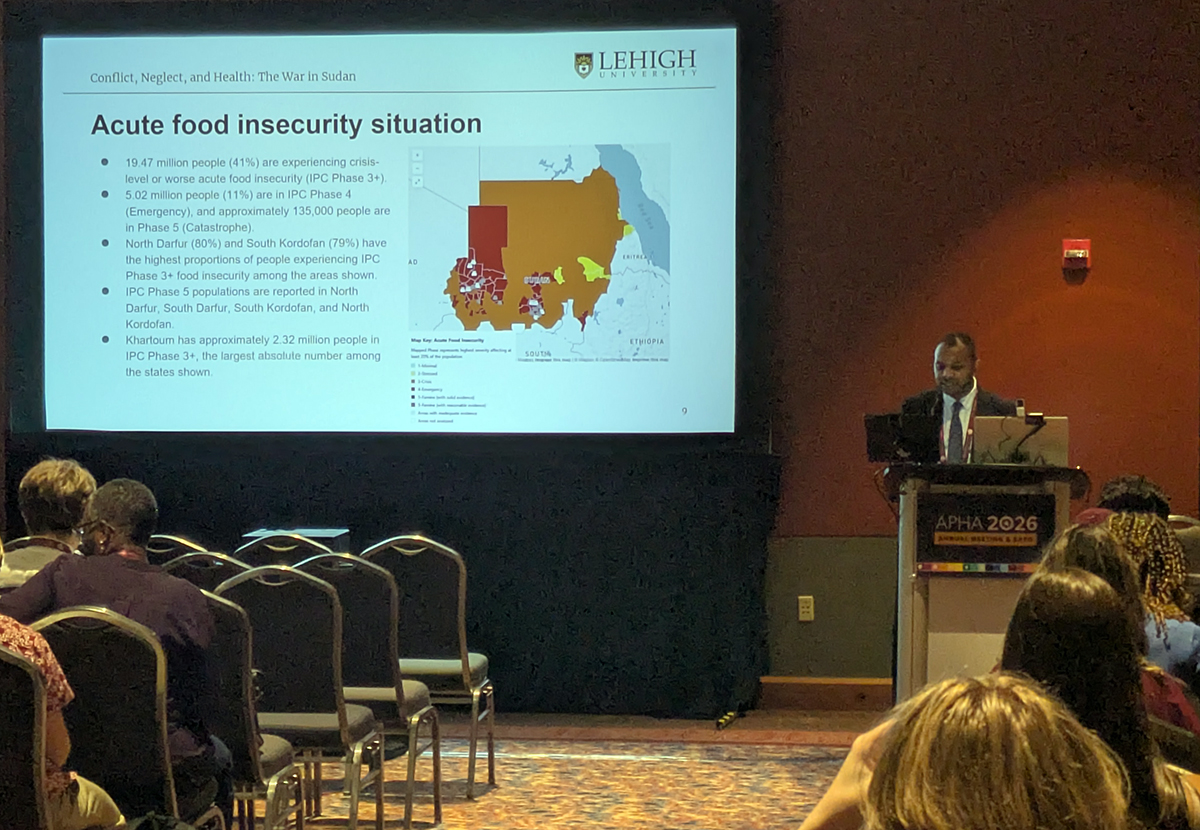
 Since military conflict began in April of 2023, the nation of Sudan in northeast Africa is experiencing the largest humanitarian catastrophe in the world today, yet it receives minimal coverage by the international media, according to College of Health (COH) professor Mohammed Jibriel, shown above. More than 15 million people have experienced displacement since the war began, and the United Nations cites that an estimated 33 million people, over half of the population, require humanitarian assistance in 2026.
Further, the public health systems have been dismantled. According to the World Health Organization, 37% of the health facilities nationwide are nonfunctional. Conflict, mass displacement and the breakdown of essential services have contributed to outbreaks of infectious diseases, including cholera, measles, dengue fever and malaria.
Jibriel, who is Sudanese, is an assistant professor in the department of community and global health at the COH. He recently drew attention to this underrecognized crisis at the American Public Health Association (APHA) 2026 Meeting and Expo, one of the world's largest and most influential public health gatherings.
“This is the reality of the world that we live in, that conflicts in Black Muslim majority nations just are not seen as urgent; they are treated as secondary,” he said, noting that racism and Islamophobia play a factor.
Following a short, 15-minute presentation at the 2025 conference on this topic, he was invited to organize a comprehensive 90-minute session in 2026, which he said is a rare opportunity. The presentation was entitled “Sudan in Crisis: Health Systems, War and Arts-Based Healing.”
Jibriel said that it was a huge success. “I’m so happy with how it turned out,” he said. “I collaborated with an organization called the Sudanese American Physician Association (SAPA), which is based here in the United States, and this is literally the organization that is saving the healthcare system in Sudan,” he said.
The session featured a presentation by Anmar Homeida with SAPA, who discussed the organization’s work to sustain and recover health system functions in Sudan, as well as to support Sudanese refugees in Chad and Uganda. Tamador Gibreel is a Sudanese actress and licensed mental health counselor whose work bridges the performing arts and mental health counseling. She spoke about the role of the arts in responding to Sudan’s mental health crisis, and Ruaa Hassalla from the American Academy of Family Physicians shared how conflict and displacement affect trust, social networks, help-seeking and community well-being among Sudanese communities.
“I started the session by providing a big-picture overview analysis of the public health crisis. It was a really wonderful session because we looked at what’s going on from different angles, from a public health, medical, community and art perspectives.”
Rather than focusing on the political situation, Jibriel’s focus was on the scale of the public health crisis.
“When I talk about gender-based and sexual violence, rape is being used as a weapon of war,” he explained. “I want to talk about the mental health crisis. I want to talk about the toxic stress experienced by children who have lost everything. I want to talk about food insecurity. The western part of Sudan is actually going through a famine right now. People are literally eating animal feed.”
Jibriel said that the audience expressed shock and anger at the scale of the crisis and asked how they could help.
“My biggest message is that we need awareness,” he said. “This should not be a secondary issue that is not discussed in public health discourse or in international media.” He also directed audience members to support the work of SAPA, support Sudanese-led research, strengthen academic and professional partnerships and invest in community-led public health initiatives.
Jibriel’s presentation on the crisis in Sudan ties directly to his ongoing research, which focuses on improving the health outcomes of marginalized and underserved communities, both medically and socially. As a Lehigh University/United Nations partnership faculty fellow, he is conducting research focusing on social protection for Sudanese migrants who were displaced because of the war. He will soon recruit COH students to serve as research assistants for this project. Further, he will engage students in conducting a scoping review of the existing research on the conflict in Sudan to identify key themes and gaps and inform policy recommendations.
A few weeks before the APHA Expo and Meeting, Jibriel was invited to speak about the public health consequences of the war in Sudan at the Association of Sudanese American Professors in America (ASAPA) Annual Conference, held virtually on October 24-25. The conference, titled “Post-War Sudan – Roadmap to Governance, Reconstruction and Civic Engagement,” brought together scholars, policymakers, and other participants to discuss Sudan’s future. Among those in attendance were Dr. Abdalla Hamdok, former Prime Minister of Sudan, and several former members of his cabinet.
Last spring at Lehigh, Jibriel taught a Global Perspectives on Health course, with a week spent learning about war as a structural determinant of health and using Sudan as a case study. Jibriel’s research and advocacy efforts underscore the College of Health’s mission to develop sustainable solutions to improve lives and promote health, whether in the Lehigh Valley or around the globe.


