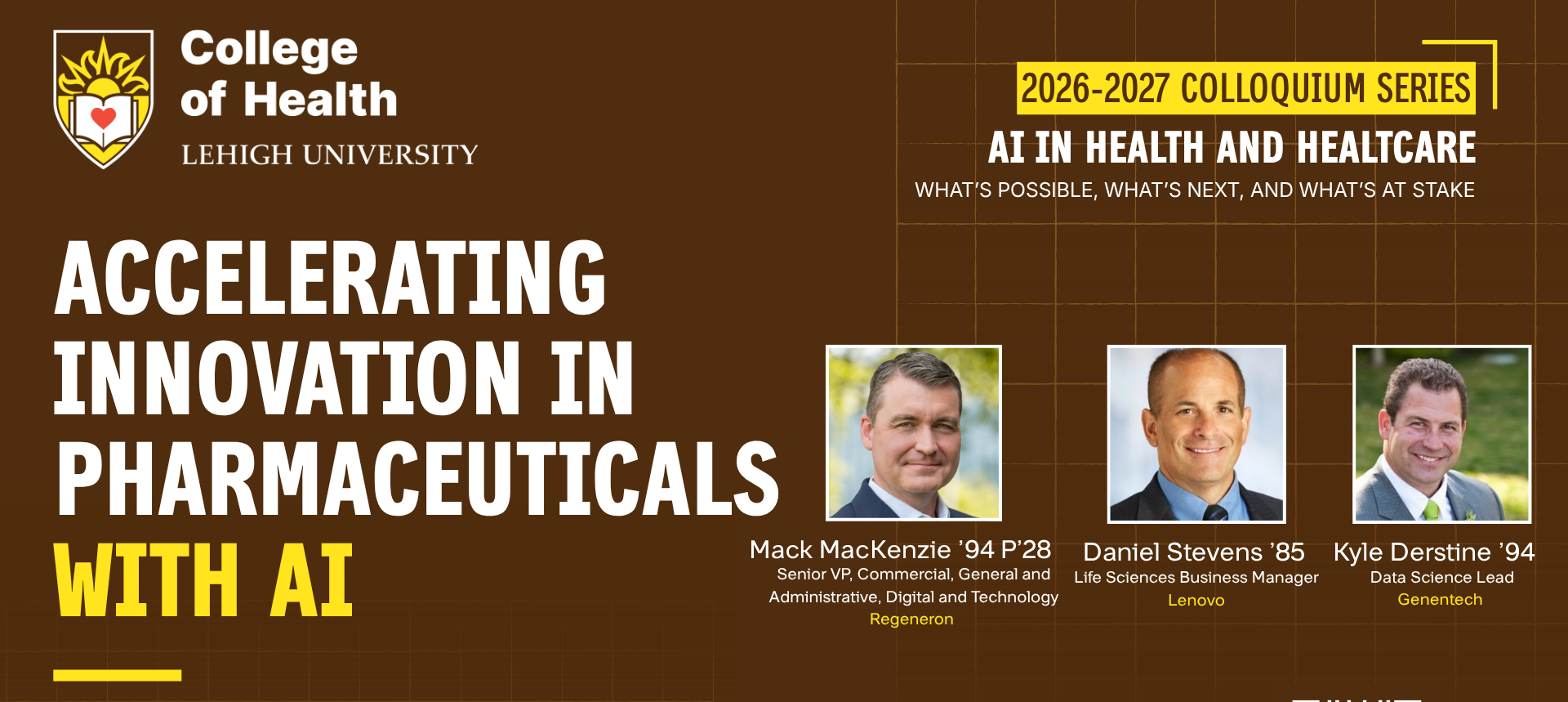
 Artificial intelligence is creating new possibilities in pharmaceutical innovation, transforming every step in the process. On September 30, Lehigh’s College of Health opened the 2026-27 College of Health Colloquium Series with “Accelerating Innovation in Pharmaceuticals with AI,” bringing together industry leaders across pharmaceutical, technology and data science for a candid look at how AI is being used to improve healthcare.
The all-Lehigh alumni panel included Daniel Stevens ’85, Life Sciences Business Manager at Lenovo; Kyle Derstine ’94, Data Science Lead at Genentech; Mack MacKenzie ’94, Senior VP, Commercial, General and Administrative, Digital and Technology at Regeneron. Gideon Gogovi, assistant professor, department of biostatistics and health data science, moderated the panel.
To provide context, Stevens, who leads AI solutions for Lenovo, offered an overview of the drug discovery, drug development and market optimization process, noting how AI has augmented all of these phases.
“As I look at that drug discovery pipeline all the way from discovery to commercialization, it’s approximately, depending on the drug and some nuances, about $5 billion in eight to 10 years to bring a drug to market,” Stevens said. “In this industry, it’s get that pipeline with quality candidates, move quickly through that pipeline, and most importantly, fail early.”
Stevens said that the number one conversation in the pharmaceutical field right now is how to improve their performance and apply AI to augment those pipelines.
The conversation turned to the impact of AI on data. MacKenzie noted that shortening the time spent on research and development has tremendous, compounding benefits for the patient, such as getting breakthroughs into the hands of patients faster and reducing costs of the drug development lifecycle. He also noted the incredible speed at which AI can sift through the sheer volume of research related to a new drug.
Derstine shared that AI is making great strides in digital pathology by helping to make faster diagnoses and get patients on medication more quickly — hopefully the exact one for their tumor type.
The panel discussed how AI is influencing clinical trials, including social listening, which uses AI to analyze online conversations about health and behavior to advertise an opportunity to join a clinical trial. They also considered the challenges of obtaining useful data from clinical trials and how AI could help researchers evaluate and refine the inclusion and exclusion criteria to make trials more accessible to underserved populations.
According to Mackenzie, patient recruitment is a big challenge in the industry. AI and advanced technology can help connect clinical systems directly to electronic medical record systems within health networks, allowing for a much faster and effective way to identify the right patients and enroll them more quickly. They also discussed ways in which AI is affecting sales and marketing, bringing increased awareness of a drug to both the consumer and prescribing physicians.
Gogovi asked the panelists how AI is reshaping roles and responsibilities within organizations, and whether it is replacing workers. According to Mackenzie, “AI is giving everyone a superpower, and constant education and learning about AI tools will be required to be successful at work.”
Stevens said that critical thinking tools are going to be invaluable in tandem with the use of AI, especially in a highly regulated environment. Derstine added that jobs are shifting as models are being built that provide fast answers to very complex questions. “What you are going to see is more higher-level professional jobs, and for some of the basic jobs, people are going to need to upskill,” he said.
The panelists encouraged all the students on the call to embrace AI, and according to Stevens, ongoing learning will become your “secret weapon.” “Using AI and taking the approach to constant learning is going to be a necessity for a successful career journey in your path moving forward,” he said.
Mackenzie encouraged the students to “stay hungry and intellectually build.”
Derstine added, “Who can ask the best question to impact the business? Because you are going to get the answer, but if it’s the wrong question, then you can’t get where you want to go. Think about that deeply and make sure that you’re a good questioner.”
The conversation about harnessing this evolving technology to improve health and healthcare continues later this fall with “AI-Powered Population Health and Preventive Care.” For more information about the 2026-27 College of Health Colloquium Series and to see the event recording, click here.


